2025

Redesigning the surface where support teams spend their day

Summary

Front is a customer operations platform used by 9,000 companies and 120k people weekly.

As Front shifted from email to multi-channel support, patterns that had worked for years were no longer scalable. We redesigned the inbox into a focused, ticketing-based workspace, iterating through internal and external betas. The new foundation unlocked further work like our AI copilot and other inbox improvements.

Role

Worked closely with the head of design and two other designers in a highly collaborative environment, co-leading the new visual system that scaled across the whole product.

Ramping up on a conversation was critical for support agents, but tags and the header structure crowded the interface.

We simplified the layout and made sections collapsible, so agents could focus in on the conversation.

We introduced a new top-level tab system of Open, Later, and Done that better reflects how support agents triage conversation.

As the inbox evolved from a traditional model to ticketing with more customisable statuses, the old structure caused conversations to get lost.

We explored a new way of working through the inbox, running sessions with customers and internal support teams to find where it broke and where it could open up new ways of working.
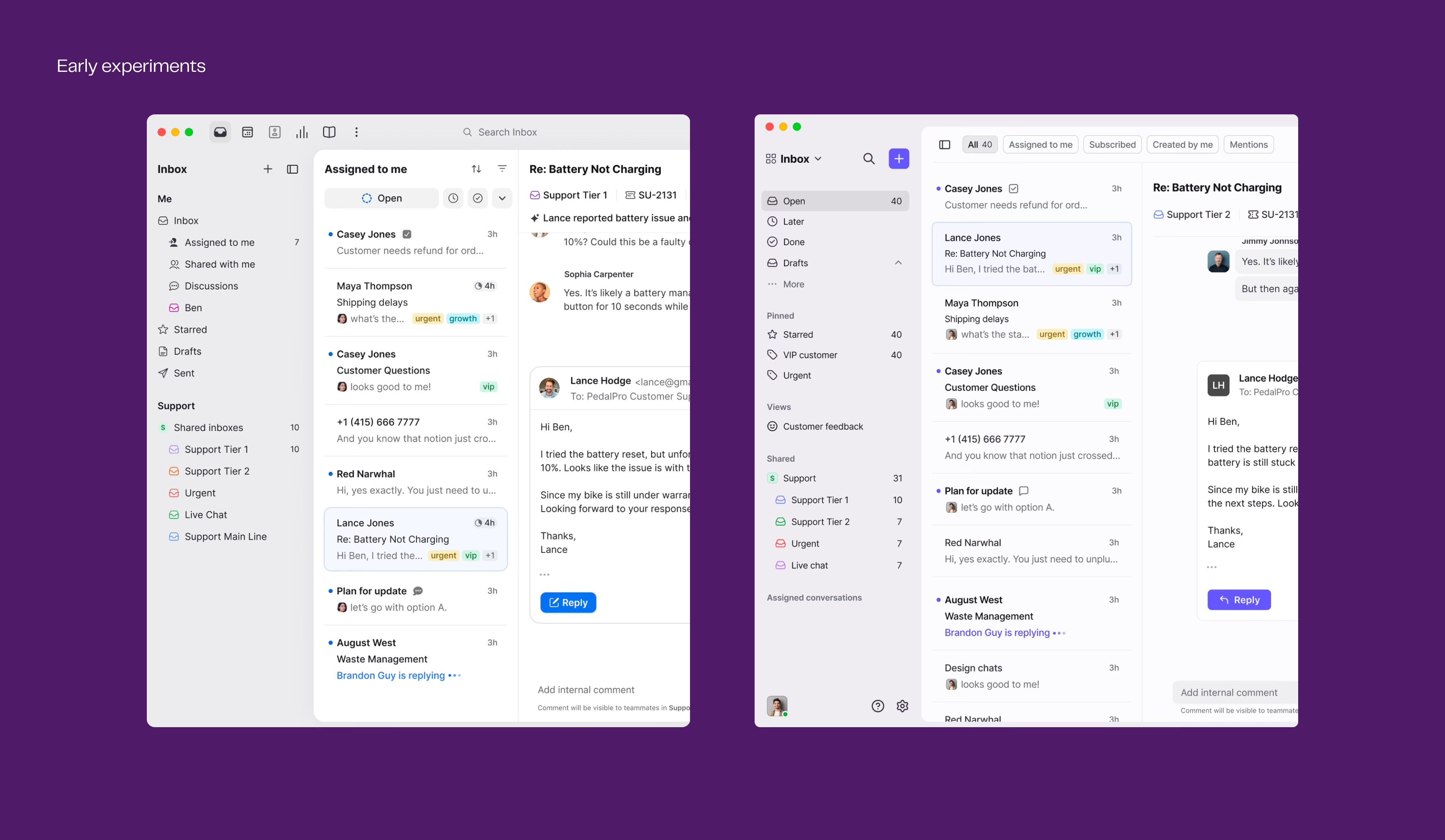
Creating a conversation system that adapts to every variation without sacrificing readability and scannability.

We learned how support agents rely on tags for context and reply-time goals for urgency. Customers had been relying on inbox colour labels as a workaround to flag urgency on live chat channels. All these learnings and more shaped how we refined content lockups, reorganised metadata, and introduced variable heights for quicker scanning.

We learned how support agents rely on tags for context and reply-time goals for urgency. Customers had been relying on inbox colour labels as a workaround to flag urgency on live chat channels. All these learnings and more shaped how we refined content lockups, reorganised metadata, and introduced variable heights for quicker scanning.

Creating a consistent dropdown pattern that reduced clicks and unlocked more powerful filtering in the inbox and across other areas of the product.

Laying the foundation for an AI assistant that has full customer context surfacing how issues have been resolved previously and helping generate a reply.

Working closely with designers to create a shared AI system that scaled across all of Front's AI products.

Simplified customer setup calls

Onboarding team noted how this made customer walkthroughs quicker and easier.

Simplified customer setup calls

Onboarding team noted how this made customer walkthroughs quicker and easier.

Improved team velocity

Built a shared language across design and engineering, so the team could move more efficiently and build on foundations that reflected the product's direction.

Improved team velocity

Built a shared language across design and engineering, so the team could move more efficiently and build on foundations that reflected the product's direction.

33%

Increase in mentions of ease of use in NPS compared to pre-redesign levels, which had remained stagnant for over 18 months.

33%

Increase in mentions of ease of use in NPS compared to pre-redesign levels, which had remained stagnant for over 18 months.