

Disputes that arise from the breakdown of a relationship can be particularly expensive, especially for those who don’t qualify for legal aid.
Starting as a proof of concept, the federal government provided funding to investigate how online dispute resolution could offer an affordable solution for separating couples.

Guiding principles

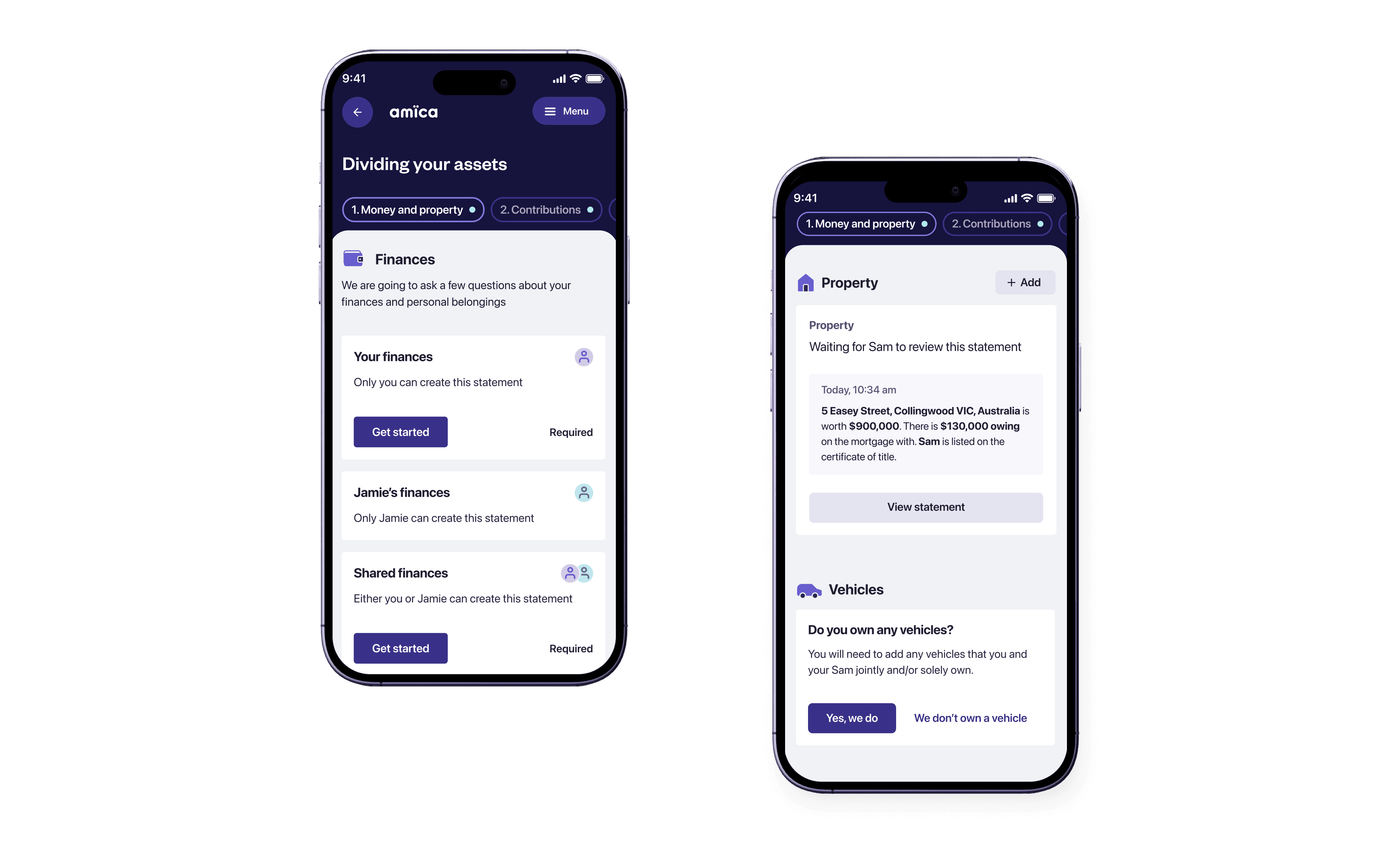
A lot of the feedback received was around how helpful it was to view the process step by step in plain conversational language.
Working closely with family lawyers, the user flow was based on the order they typically follow. Questions are asked one at a time to reduce cognitive load and provide additional context and clarification if needed. The language is conversational in nature and applied contextually throughout to provide support and explanations along the way.

Feedback highlighted the importance of creating a more collaborative approach to reviewing statements to help separating couples move through the process as quickly as possible.


Fairness was the foundation throughout the design of the negotiation process, as users elect to either agree to the AI powered suggestion or use it as a guide.
AI provides a suggestion of what a lawyer would consider a fair division of their assets based on the information they’ve entered. Instead of using published case data to power the machine learning algorithm, (which the team found contained biases), the team created there own data model that lawyers contributed to.
Hints and alerts provide guidance if you attempt to make an unfair offer (outside the bounds of the prediction).

Recognition
ABC News article: ‘New online program for couples going through divorce could keep disputes out of court’
Watch Amica being featured on The Project, Channel 10
Director of National Legal Aid, Gabrielle Canny’s talk on 3AW: ‘DIY divorce: How artificial intelligence is cutting lawyers out of separation’
Awarded the iAward 2020 for Best Government and Public Sector Solution